Garage tool review
Rust-Oleum RockSolid Garage Floor Kit Review
Buy the Rust-Oleum RockSolid kit if you want a durable one-coat garage floor you can walk on the same day and park on the next, because polycuramine cures faster and resists hot tire pickup far better than the water-based epoxy kits sold beside it. Skip it if you are not going to prepare the concrete properly, because every failed garage floor coating in existence failed at the concrete, not at the product.
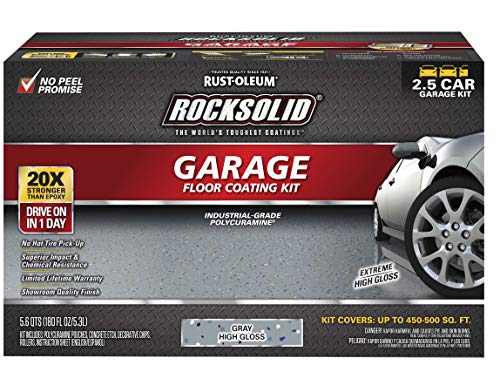
Rust-Oleum RockSolid Polycuramine High Gloss Garage Floor Coating Kit
about $250
Check price on AmazonAs an Amazon Associate we earn from qualifying purchases, at no extra cost to you. Prices change; the figure above is what we last saw.
| Spec | Rust-Oleum RockSolid Polycuramine High Gloss Garage Floor Coating Kit |
|---|---|
| Chemistry | Polycuramine, two-part, patented burst pouch |
| Strength claim | Rust-Oleum states 20 times stronger than epoxy |
| Coverage | Up to 500 sq ft per kit, depending on surface porosity |
| Walk-on time | 8 to 10 hours |
| Vehicle ready | 24 hours |
| Coats | One coat, self-leveling and buildable |
| Application temperature | 40 to 90 degrees Fahrenheit |
| Finish | High gloss terrazzo look, resists hot tire pickup and chemical spills |
| VOC and odor | Low odor, low VOC |
Specs come from Rust-Oleum's published product bullets returned by the Creators API. Price is approximate.
Prep is the product
Nothing about a garage floor coating matters as much as what happens before the coating comes out of the pouch. The slab has to be free of oil, free of any previous sealer, mechanically profiled by grinding or properly acid etched, vacuumed, and genuinely dry. Skip any of that and the coating bonds to a contaminant rather than to concrete, and it will lift in sheets when a hot tire grips it. Renting a concrete grinder for a day is the single highest-return decision in this project, and it is worth more than upgrading the coating.
Moisture is the failure nobody sees coming
Concrete on grade wicks moisture from the soil beneath, and vapor pressure under a coating will debond it no matter how well the surface was prepared. Tape a two foot square of plastic sheet to the slab overnight and check for condensation underneath before you commit. If moisture is present, the honest answer is to solve the drainage first. Our crawl space encapsulation vs vapor barrier comparison covers the same principle underneath a house, and basement waterproofing costs price the wider job when the moisture is structural.
DIY kit or professional floor
A professionally installed polyaspartic garage floor costs several times a kit and buys you diamond grinding, crack repair, a full flake broadcast and a clear topcoat applied by people who do it daily. Our epoxy vs polyaspartic garage floor cost comparison lays out what that difference actually buys, and the epoxy garage floor cost calculator prices your own garage. The honest summary: a well-prepped kit floor looks excellent and lasts years, a professional floor lasts longer and survives worse treatment, and the gap between them is mostly prep and topcoat rather than magic.
Coverage, and buying enough
Rust-Oleum states up to 500 square feet per kit depending on porosity, and porous or freshly ground concrete drinks more than the label figure suggests. Measure your garage, then buy for the low end of the coverage range rather than the high end, because running out mid-floor is unrecoverable: the product cures on its own schedule and a cold joint across the middle of a garage is permanent. A typical two car garage sits close enough to 500 square feet that two kits is often the right call.
The honest weakness: the pot life gives you no second chances
Once the burst pouch is activated the clock is running and it does not stop for a phone call, a missing roller or a realisation that you should have taped the edges first. Owners consistently describe the working time as short and the process as unforgiving, and it is the reason a helper matters more here than on almost any other DIY finish. The coating is also genuinely glossy, which shows every imperfection in the slab beneath it and becomes slippery when wet unless you broadcast the supplied flakes or add a grit additive. And like all coatings it is only as good as the prep, so the strength claims on the box describe the material, not the floor you will end up with.
What owners consistently report
Published owner reviews divide sharply along one line: people who ground or etched the slab and let it dry report floors that still look new after years, and people who cleaned and painted report peeling within a season. The short working time is the most repeated practical complaint, the low odor is the most repeated pleasant surprise compared with solvent epoxies, and the most repeated piece of advice is to buy an extra kit rather than risk running short.
Who it suits
- Garages, workshops and basement floors on sound, dry concrete
- Owners willing to grind or etch and wait for the slab to dry
- Anyone who needs the car back in the garage within a day
- Floors where hot tire pickup has already ruined a cheaper coating
Who should skip it
- Slabs with active moisture or drainage problems
- Floors with significant cracking or spalling that needs repair first
- Anyone planning to apply it alone with no helper
- Garages that cannot be kept between 40 and 90 degrees during application and cure
Safety, stated plainly
Grinding concrete releases respirable crystalline silica, which causes silicosis and lung cancer, so use a grinder with dust extraction and a fitted respirator rather than a shop vacuum and a paper mask. Acid etching involves a corrosive that requires eye protection, chemical gloves and ventilation, and acid must be added to water rather than water to acid. Ventilate the garage during application even though the product is low odor, and keep the finished floor from becoming a slip hazard by broadcasting flakes or adding an anti-slip additive.
Alternatives worth comparing
about $128
The same coating in dark gray, which hides tire marks and dust far better than the light gray in a garage that gets used rather than admired, and it is the cheaper kit for a single bay.
View on Amazonabout $161
A lower-priced kit in the same high gloss gray, worth choosing when the floor is small enough that one kit will comfortably cover it with margin.
View on AmazonHow we researched this
We did not test the Rust-Oleum RockSolid Polycuramine High Gloss Garage Floor Coating Kit in person, and nothing here is written as though we did. This review is drawn from the manufacturer's published specifications, the product's own documentation, and the consensus of published owner reviews, which is summarised as exactly that rather than presented as our own use. Specifications are sourced as noted under the table above, and prices are approximate and move. Cost figures elsewhere on this site are 2026 estimates, not quotes. This is researched information, not professional advice: anything touching electrical, gas, structural, roofing or hazardous material work should go to a licensed professional and through your local permitting process. For the cost side of this decision, see Polyaspartic vs Epoxy.
Frequently asked questions
How long does a RockSolid garage floor last?
It depends almost entirely on preparation. On a ground, clean, dry slab, owners commonly report floors that still look good after several years of normal use. On a slab that was only cleaned and coated, failures within a year are common. The chemistry is durable; the bond is what fails.
Do I have to grind the concrete first?
You have to profile it somehow. Diamond grinding is the best option and renting a grinder for a day is the highest-value spend in the whole project. Acid etching is the alternative and works on some slabs, but it is less reliable on dense, power-troweled concrete and it introduces its own handling hazards.
RockSolid versus professional polyaspartic: what is the difference?
A professional floor includes diamond grinding, crack and joint repair, a full flake broadcast and a clear polyaspartic topcoat, applied by a crew who do it daily. That combination survives harder use and lasts longer. A well-prepped kit floor gets most of the appearance at a fraction of the price, and the epoxy vs polyaspartic comparison sets out where the extra money goes.
How many kits do I need for a two car garage?
A typical two car garage is close to or above the 500 square foot coverage of one kit, and porous or freshly ground concrete absorbs more than the label figure. Buy two rather than risk running out, because the product cures on its own schedule and a joint where you stopped is permanent.
Is a coated garage floor slippery?
A high gloss coating is slippery when wet, which matters in a garage where cars bring in snow and rain. Broadcasting the supplied decorative flakes adds texture, and an anti-slip additive mixed into the coating adds more. Decide before you pour, because you cannot add it afterwards.