Tile tool review
DEWALT D24000S Wet Tile Saw Review
Buy the DEWALT D24000S if you are tiling more than one room, working with large format porcelain, or you tile often enough that a rental counter trip is an annoyance, because its stainless rollers and cutting cart hold accuracy to within about 1/32 inch over an 18 inch cut. Skip it if you are tiling a single bathroom floor, because at around $999 the saw can cost more than the tile and a weekend rental will do the same job.
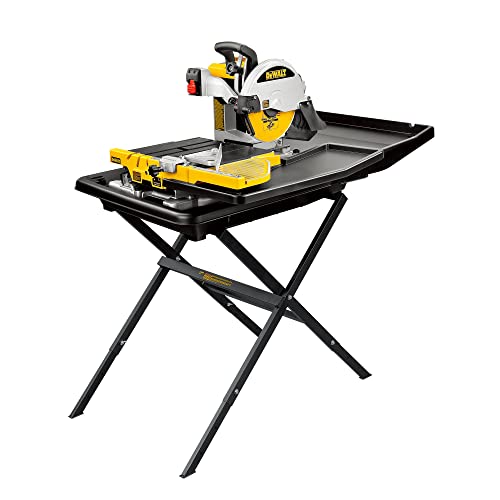
DEWALT D24000S 10-Inch Wet Tile Saw with Stand
about $999
Check price on AmazonAs an Amazon Associate we earn from qualifying purchases, at no extra cost to you. Prices change; the figure above is what we last saw.
| Spec | DEWALT D24000S 10-Inch Wet Tile Saw with Stand |
|---|---|
| Motor | 120V, 1.5 peak horsepower |
| Blade | 10 inch, 5/8 inch arbor, XP4 porcelain blade included |
| Diagonal cut capacity | 18 by 18 inches |
| Max rip with plunge | 28 inches |
| Max depth of cut | 3-1/8 inches |
| Bevel | 45 degrees |
| Accuracy | Within 1/32 inch over an 18 inch cut |
| Weight and size | 69 lb, 36 in L by 29 in W by 24 in H |
| Included | Stand, submersible pump, water pan and trays, rip guide |
Specs come from DEWALT's published product bullets returned by the Creators API. Price is approximate.
Why the cart design matters more than the motor
Cheap wet saws move the tile across a fixed blade on a plastic table, and any grit under the tile becomes a wander in the cut. The D24000S puts the tile on a cart that rides stainless steel rollers past the blade, so the tile never slides on a surface at all. DEWALT publishes accuracy within 1/32 inch over an 18 inch cut, and that is the number that decides whether your grout lines stay parallel across a wall. For large format porcelain, where a wandering cut is visible from across the room, the cart is the reason to buy this saw rather than a table-style one.
Capacity, and what fits
An 18 by 18 inch diagonal capacity and a 28 inch rip with the plunge feature covers most residential tile, including 12 by 24 planks cut lengthwise. What it does not comfortably cover is the very large format slab tile that has become common in showers, where 24 by 48 panels need either a rail saw or a scoring and snapping approach. Check the actual size of the tile you have chosen before you buy the saw, because the tile decides the tool and not the other way round.
Buy or rent: the honest math
A wet saw of this class rents from tool counters and home centers for a fraction of the purchase price for a weekend, and for a single bathroom floor that is almost always the cheaper answer. Price the job first in the tile installation cost calculator, then compare the labor you would displace against $999 plus blades. The saw starts to make sense at about the point where you are tiling a floor, a shower and a backsplash across a whole remodel, or where you tile something every year. If the tile choice itself is still open, tile vs luxury vinyl plank cost is the comparison that changes the budget most, because vinyl plank needs no wet saw at all.
Water, mess and where you can run it
A wet saw sprays a fine slurry, and the trays contain most of it but not all of it. Set up outdoors, in a garage with the door open, or inside a plastic sheet enclosure, and never on a finished floor you care about. The pump must stay submerged and the pan must stay topped up, because a blade running dry for even a few seconds both ruins the cut and glazes the diamond rim. Water and 120V power in the same place is exactly the situation a ground fault circuit interrupter exists for, so plug into a GFCI protected outlet and never bypass one to stop nuisance tripping.
The honest weakness: heavy, thirsty and slow to set up
At 69 pounds for the saw alone, plus a stand, plus water, this is not a tool one person moves casually or sets up for a single cut. Owners consistently report that the water tray design lets slurry escape at the back of the cart during plunge cuts, and that cleaning the pan and pump after each session is a real chore rather than a rinse. None of that is a defect, it is what a saw of this type is, but if you were imagining lifting it out for ten minutes of work you will not use it that way.
What owners consistently report
Published owner reviews converge on three things: cut quality is excellent and stays excellent, the included XP4 blade is genuinely good rather than a throwaway, and setup and cleanup are the price you pay. Professional tile setters are the loudest advocates, and the most common complaint from occasional users is not about performance at all but about storage, because a saw this size takes a real corner of a garage.
Who it suits
- Whole-house or multi-room tile projects
- Large format porcelain where a wandering cut shows
- Anyone tiling regularly rather than once
- Jobs with many miters, plunge cuts or bevels
Who should skip it
- A single small bathroom floor
- Backsplash-only projects, where a manual snap cutter and a grinder do most of it
- Homes with no outdoor or garage space to run a wet saw
- Slab tile larger than the 18 inch diagonal capacity
Should you rent instead?
For one bathroom, rent. A weekend rental of a comparable wet saw costs a small fraction of $999, and you will not have to store it, clean it out or find a buyer for it afterwards. Buying makes sense when the total tile work in front of you spans several rooms, or when you expect to tile again within a couple of years.
Safety, stated plainly
Cutting tile, stone and concrete releases respirable crystalline silica, which is a documented cause of silicosis and lung cancer. Water is the control: a wet saw run properly suppresses most of that dust, which is exactly why you should never run one dry to save setup time, and why dry cutting tile with a grinder indoors is a genuinely bad idea without extraction and a fitted respirator. Wear eye protection against the spray and chips, use a GFCI protected circuit, and keep the blade guard in place. If a tile binds, switch off and let the blade stop rather than pulling it free.
Alternatives worth comparing
about $80
A tenth of the price and adequate for a backsplash or a small floor in standard format tile, which makes it the honest recommendation when the alternative is spending $999 once and never again.
View on Amazonabout $1,349
Extends the cutting capacity for the bigger plank and panel tile the D24000S cannot take, which is the only reason to spend more rather than a general upgrade.
View on AmazonHow we researched this
We did not test the DEWALT D24000S 10-Inch Wet Tile Saw with Stand in person, and nothing here is written as though we did. This review is drawn from the manufacturer's published specifications, the product's own documentation, and the consensus of published owner reviews, which is summarised as exactly that rather than presented as our own use. Specifications are sourced as noted under the table above, and prices are approximate and move. Cost figures elsewhere on this site are 2026 estimates, not quotes. This is researched information, not professional advice: anything touching electrical, gas, structural, roofing or hazardous material work should go to a licensed professional and through your local permitting process. For the cost side of this decision, see Tile vs Luxury vinyl plank.
Frequently asked questions
Should I buy or rent a wet tile saw?
For one bathroom, rent. A weekend rental costs a small fraction of the $999 purchase price and you avoid storing and cleaning a 69 pound saw. Buy when the work spans multiple rooms, when the tile is large format and cut quality matters, or when you tile often enough that rental trips add up.
Can the DEWALT D24000S cut 12 by 24 porcelain?
Yes. The rip capacity with plunge is 28 inches and the diagonal capacity is 18 by 18 inches, so a 12 by 24 plank cuts lengthwise or across without difficulty. The included XP4 blade is specified for porcelain, which is the harder material and the one that punishes a cheap blade.
Is a wet saw safer than dry cutting tile?
For dust exposure, yes, and it is not a small difference. Cutting tile and stone releases respirable crystalline silica, and water suppression is the recognised control. That is a reason to keep the pump running and the pan full rather than running the saw dry for a quick cut, and a reason to avoid dry cutting tile indoors with an angle grinder.
Do I need a GFCI outlet for a wet tile saw?
Yes. The saw combines mains voltage with running water, which is the exact case ground fault protection is designed for. Use a GFCI protected outlet or a GFCI extension, and if it trips repeatedly treat that as a fault to be diagnosed rather than a nuisance to be bypassed. Any doubt about the circuit itself is a question for a licensed electrician.
What blade should I use for natural stone?
A continuous rim diamond blade rather than a segmented or turbo rim blade, because stone chips at the exit edge with an aggressive blade. The XP4 blade included with the saw is aimed at porcelain. Marble and travertine cut best slowly with plenty of water and a blade sold specifically for stone.