Exterior cleaning tool review
Westinghouse WPX2300e Pressure Washer Review
Buy the Westinghouse WPX2300e if you want to clean a driveway, a deck, siding or patio furniture a few times a year and you would rather store something the size of a suitcase than maintain a gas engine, because an induction motor and a GFCI cord make it about as low-commitment as this category gets. Skip it if you are cleaning a large commercial area or stripping heavy coatings, because flow rate rather than pressure is what does that work and 1.76 gallons per minute is modest.
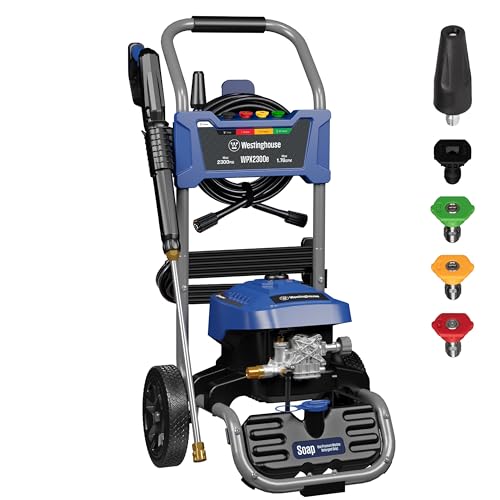
Westinghouse WPX2300e Electric Pressure Washer
about $161
Check price on AmazonAs an Amazon Associate we earn from qualifying purchases, at no extra cost to you. Prices change; the figure above is what we last saw.
| Spec | Westinghouse WPX2300e Electric Pressure Washer |
|---|---|
| Max pressure | 2,300 PSI |
| Rated pressure | 1,900 PSI |
| Max flow | 1.76 GPM |
| Rated flow | 1.2 GPM |
| Motor | 120V AC induction |
| Pump | Axial 3-piston, maintenance free, auto-stop |
| Hose | 25 ft abrasion resistant, high pressure metal gun and wand |
| Nozzles | 5 quick connect: 0, 15, 25 degree, soap and turbo |
| Soap tank | 0.42 gallon onboard |
| Cord | 35 ft with GFCI |
| Warranty | 3 year limited |
Specs come from Westinghouse's published product bullets returned by the Creators API. Price is approximate.
Rated PSI is the honest number
Pressure washers are marketed on maximum figures measured under ideal conditions, and Westinghouse deserves credit for publishing both: 2,300 max PSI against 1,900 rated, and 1.76 max GPM against 1.2 rated. Rated is what you will actually work with. It is also worth knowing that flow, not pressure, is what carries dirt away, which is why a machine with more gallons per minute cleans a driveway faster than one with a higher pressure number and less flow. Compare rated figures across machines and the marketing gap mostly disappears.
What it will and will not clean
Comfortably: decks, fences, patio furniture, cars, garage floors and vinyl siding. Slowly: a large concrete driveway, which is where a surface cleaner attachment makes an enormous difference and where the M22 fitting on this machine matters. Not really: heavy paint stripping, large commercial areas, and anything needing sustained high flow. If your goal is preparing a driveway for sealing, the cleaning is the easy half and the sealer is where the result comes from, priced in the driveway sealing cost calculator. If the driveway itself is failing rather than dirty, our asphalt vs concrete driveway cost comparison and the concrete driveway cost calculator are the more useful pages.
Buying versus hiring the job out
Professional pressure washing is priced by area and by trip, and a single visit for a house and driveway often costs more than this machine. That is the honest argument for owning one: it pays for itself in roughly one to two visits and then keeps working. Price a professional job in the pressure washing cost calculator and compare. The exception is a two-story house, where the real cost is reach and safety rather than the machine, and where a professional with the right equipment is genuinely better placed than you on a ladder with a wand.
Painting prep, and the thing people get wrong
Washing before painting is standard practice, but a pressure washer forces water behind siding and into joints, and paint applied over trapped moisture fails. Wash, then wait for the substrate to dry properly, which in humid weather means days rather than hours. Our Graco Magnum X5 review covers the spraying side, the exterior painting cost calculator prices the job, and how much it costs to paint a house exterior covers the prep that decides how long the result lasts. Homes built before 1978 may have lead paint, and pressure washing painted surfaces disperses whatever is on them, which is regulated work: test first.
The honest weakness: modest flow, and a turbo nozzle that can damage things
1.2 rated gallons per minute is a real constraint. On a large driveway you will be there a while, and a surface cleaner attachment becomes close to essential rather than a luxury. The included turbo nozzle is the other honest caution: it concentrates the spray into a rotating point and it will absolutely etch concrete, strip paint you wanted to keep, gouge softwood decking and drive water behind vinyl siding. Most damage people do with a pressure washer comes from the turbo or the zero degree nozzle used at close range. Electric pressure washers also have a duty cycle: this is not a machine to run for four hours straight.
What owners consistently report
Published owner reviews describe a machine that starts instantly, is easy to store and does residential jobs well, with the induction motor singled out as quieter and longer lasting than the universal motors in cheaper units. The most repeated complaints are the time a big driveway takes at this flow rate and the quick connect fittings, and the most repeated recommendation is to add a surface cleaner attachment, which owners say changes the driveway experience completely.
Who it suits
- Decks, fences, patios and patio furniture
- Vinyl siding on a single story house
- Driveways and paths, especially with a surface cleaner attachment
- Anyone who wants no engine maintenance and easy storage
Who should skip it
- Large commercial areas or long continuous sessions
- Paint stripping and heavy industrial cleaning
- Two-story exterior work, which is a reach and safety problem first
- Anyone expecting the marketed max figures in normal use
Safety, stated plainly
A pressure washer jet can lacerate skin and cause an injection injury that looks minor and is not, so never point the wand at a person or an animal and never brace a hand in front of the spray. Wear eye protection and closed shoes. Use a GFCI protected supply, which this machine provides on its own cord, and never bypass it or extend it with a light household cord. Never spray into electrical outlets, fixtures, meters or service entrances, and keep the wand away from anything that could be live. Do not use a ladder and a pressure wand at the same time: the recoil is exactly the wrong force at the top of a ladder, and this is a common way people fall. Homes built before 1978 may have lead paint, and washing painted surfaces disperses it.
Alternatives worth comparing
about $400
Nearly double the flow rate at similar pressure, which is the specification that actually determines how fast a driveway cleans, and the right pick if large flat areas are the main job.
View on Amazonabout $169
A smaller anti-tipping unit at a similar price with slightly higher peak pressure, better suited to storage-limited garages and lighter, more occasional use.
View on AmazonHow we researched this
We did not test the Westinghouse WPX2300e Electric Pressure Washer in person, and nothing here is written as though we did. This review is drawn from the manufacturer's published specifications, the product's own documentation, and the consensus of published owner reviews, which is summarised as exactly that rather than presented as our own use. Specifications are sourced as noted under the table above, and prices are approximate and move. Cost figures elsewhere on this site are 2026 estimates, not quotes. This is researched information, not professional advice: anything touching electrical, gas, structural, roofing or hazardous material work should go to a licensed professional and through your local permitting process. For the cost side of this decision, see Concrete vs Asphalt.
Frequently asked questions
Is 2,300 PSI enough for a house?
For residential work, yes. Vinyl siding needs far less than that and is easily damaged by more, decks want a wide nozzle and moderate pressure, and driveways benefit more from flow rate than from pressure. Note the rated figures rather than the maximum ones: this machine is rated at 1,900 PSI and 1.2 GPM in normal operation.
Can a pressure washer damage siding?
Yes, easily. Water driven behind vinyl or lap siding gets trapped, and trapped water causes rot and paint failure long after the siding looks clean. Use a wide nozzle, spray at a downward angle rather than upward under the laps, keep your distance, and never use the turbo or zero degree nozzle on siding.
Electric or gas pressure washer?
Electric for residential work: quieter, lighter, no fuel or engine maintenance, and safe to use where exhaust would be a problem. Gas for large areas and sustained commercial use where higher flow matters and a duty cycle limit would get in the way. For a house and driveway a few times a year, electric is the sensible answer.
Do I need a surface cleaner attachment?
For a driveway, it makes a large difference. A surface cleaner spreads the water across a spinning bar under a shroud, which cleans several times faster than a wand and leaves no stripe marks. This machine takes M22 fitting accessories, so surface cleaners and foam cannons fit directly.
Should I pressure wash before painting?
Washing first is normal practice, but the surface must dry completely before paint goes on, which can take days in humid weather rather than hours. Water driven into joints and behind siding is a common cause of early paint failure. If the house was built before 1978, test for lead paint first, because washing disperses whatever is on the surface.