Garage comparison
Epoxy vs Polyaspartic Garage Floor: Cost Comparison
Both are resinous coatings over a concrete slab. Polyaspartic cures far faster, tolerates cold and does not yellow in sunlight, and it costs more. What actually decides whether either lasts is the preparation underneath.
Polyaspartic
$5 to $12 per sq ft installed
Epoxy
$3 to $8 per sq ft installed
| Feature | Polyaspartic | Epoxy |
|---|---|---|
| Installed cost per sq ft | $5 to $12 | $3 to $8 |
| Typical two-car garage | $2,500 to $6,000 | $1,500 to $4,000 |
| Cure time before driving on it | Often within a day | Several days |
| UV stability | Yes | Yellows in sunlight |
| Application temperature range | Wide, works in cold | Narrow |
| Working time for the installer | Very short | Longer, more forgiving |
| Film thickness | Thinner per coat | Thicker build |
| DIY practicality | Difficult, cures fast | Possible with care |
Polyaspartic
- Cures fast, so the garage is usable within about a day
- Applies in a wide temperature range including cold weather
- UV stable, does not yellow near a sunlit door
- Flexible, tolerates slab movement well
- Costs more than epoxy
- Very short working time makes it a professional job
- Thinner per coat, usually applied as a system with a base coat
Epoxy
- Lower cost
- Thick, hard film with good chemical resistance
- Longer working time, which makes careful DIY feasible
- Widely available in kit form
- Days of cure time before vehicles return
- Yellows where sunlight reaches it
- Sensitive to temperature and humidity during application
- Peels readily over poorly prepared or damp concrete
The verdict
Choose polyaspartic if you want the garage back quickly, if the work is happening in cold weather, or if sunlight reaches the floor through an open door. Choose epoxy for the lower cost, especially for a garage that stays shaded and where a few days of cure time is acceptable. In both cases ask specifically what surface preparation is included: diamond grinding or shot blasting plus a moisture test is what makes a coating last, and acid etching alone is the corner most commonly cut. A slab that fails a moisture test should not be coated until the source is addressed.
If the DIY route wins, our Rust-Oleum RockSolid kit review is blunt about the part that decides the outcome: coatings fail at the concrete preparation, not at the product.
Doing the garage job yourself?
Amazon picks · SponsoredA contractor quote is mostly labor. If that estimate felt steep, here is the exact gear to tackle this job yourself. As an Amazon Associate we earn from qualifying purchases, at no extra cost to you.
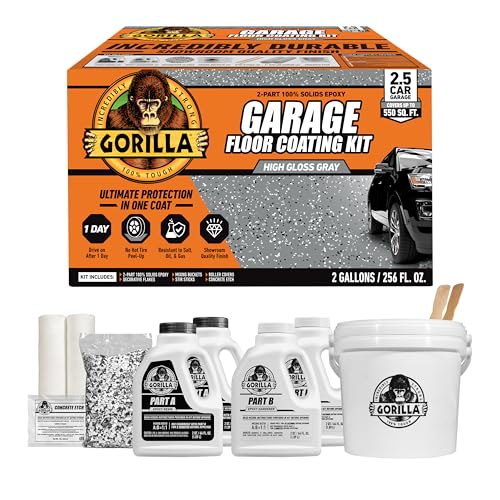
$399.00
100 percent solids 2.5-car kit covering up to 550 sq. ft. in high-gloss gray.
View on Amazon
$47.97
Single-gallon epoxy paint for a budget-friendly concrete refresh.
View on Amazon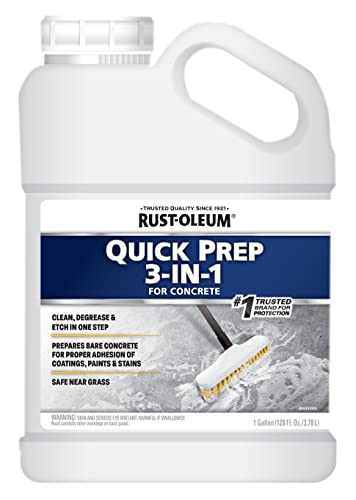
$19.97
3-in-1 cleaner, degreaser, and etch to prep concrete before coating.
View on Amazon
$19.99
Long-handle rubber squeegee for spreading coatings and clearing water.
View on AmazonFrequently asked questions
Which lasts longer, epoxy or polyaspartic?
Polyaspartic generally holds up better against sunlight and slab movement, and epoxy builds a thicker, harder film. In practice both fail for the same reason when they fail, which is inadequate surface preparation or moisture coming up through the slab. Ask about prep and moisture testing before comparing the chemistries.
Why do garage floor coatings peel?
Almost always because the concrete was not properly prepared, or because moisture is migrating up through the slab and pushing the coating off. Acid etching alone often does not create enough profile for a durable bond, which is why professional installations use diamond grinding or shot blasting. A calcium chloride or relative humidity moisture test on the slab is the other step worth insisting on.
Can I coat a garage floor myself?
Epoxy kits are sold for DIY and people do get good results, provided the prep is done properly with a rented grinder rather than an etching solution, and the slab is dry. Polyaspartic is much harder to apply as a DIY job because it cures so quickly that mistakes cannot be corrected. Budget most of the effort for preparation, not for rolling on the coating.
How long before I can park on a new coating?
Polyaspartic systems are commonly ready for vehicles within about a day, and epoxy typically needs several days for full cure before hot tyres are parked on it. Driving on an epoxy floor too early causes tyre pick-up, where the coating lifts in patches under the tyres. Follow the manufacturer figure for the specific product rather than a general rule.