How we researched this
We did not test any of these saws in person. This guide is researched from manufacturer specifications and the pattern in published owner reviews, including the owner ratings and review counts shown on grizzly.com at the time of writing. Treat it as a way to narrow the field, then read the manual for your exact model, because accuracy, fit and finish vary between individual saws.
Shopping the sale? See Black Friday DIY tool deals for the tools worth watching.
The three table saw tiers
Table saws sort into three tiers by how they are built, and the tier sets almost everything else: footprint, power, accuracy and price. A benchtop or jobsite saw is light, portable and runs on a standard 120V outlet. A hybrid saw has a cast iron top and a motor and trunnion closer to a stationary saw, but fits in a smaller shop and often runs on 120V. A cabinet saw is the stationary workhorse: enclosed base, heavy cast iron, a 3 HP motor and usually a 240V circuit.
The practical question is what your garage can support. A benchtop saw works in any garage. A hybrid needs a floor spot and a mobile base. A cabinet saw needs a dedicated place, outfeed space, and the 240V circuit priced in our garage workshop setup cost guide.
| Tier | Motor and power | Best for | Footprint |
|---|---|---|---|
| Benchtop / jobsite | Up to 15 amp, 120V | Decks, trim, sheet goods, a saw that moves | Small, on a stand |
| Hybrid | 1.5 to 2 HP, 120V or 240V | Furniture and cabinets in a garage | Medium, mobile base |
| Cabinet | 3 HP, 240V | Daily production and heavy stock | Large, fixed |
Tier one: the benchtop saw
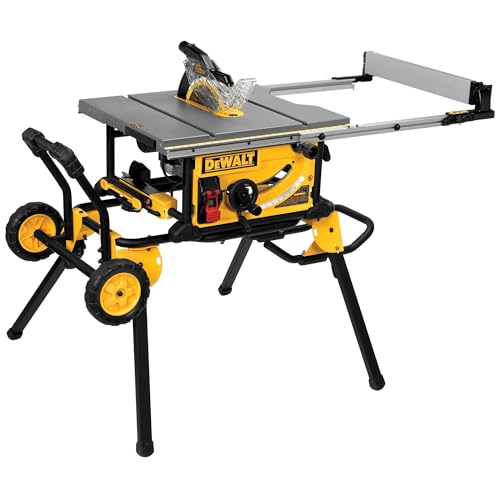
The benchtop tier is the right answer for most readers. On Amazon the pick is the DEWALT DWE7491RS: 15 amp, 32-1/2 inches of rip capacity and a rack and pinion fence that stays square. Our DEWALT DWE7491RS table saw review covers its strengths and the honest weaknesses, mainly its weight and a weak stock miter gauge.
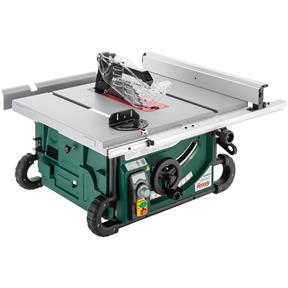
The Grizzly alternative is the G0869, a 10 in, 2 HP variable-speed benchtop saw that is owner-rated 4.8 on grizzly.com across 145 reviews. Variable speed is the feature to weigh: it lets you slow the blade for certain materials. A benchtop saw is the better fit if the saw sits on a bench or a mobile base in the garage; the DEWALT is the better fit if the saw rides in a truck to job sites.
Tier two: the hybrid saw
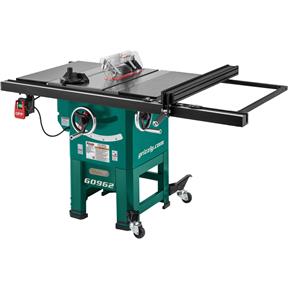
A hybrid is what you buy when you have outgrown a benchtop saw and want accuracy and mass without a 240V circuit and a shop to match. The Grizzly G0962 is a 10 in, 2 HP open-stand hybrid, owner-rated 4.4 on grizzly.com across 50 reviews. An open stand means the base is a frame, not an enclosed cabinet, which keeps weight and cost down while giving a cast iron table and a better fence than the benchtop tier.
The trade is footprint: a hybrid wants a spot and a mobile base, and it is heavy to move. On Amazon, the SawStop contractor saw is the closest contractor-class alternative, and it adds a flesh-sensing brake that stops the blade on contact. Choose by whether that safety feature matters more to you than the budget, since the Grizzly route is the lower-cost one to a stationary-saw feel.
Tier three: the cabinet saw
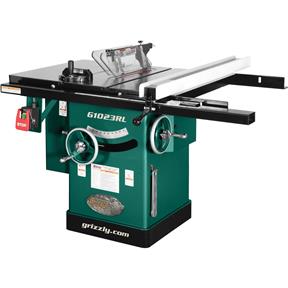
A cabinet saw is a commitment. The Grizzly G1023RL is a 10 in, 3 HP, 240V cabinet saw, owner-rated 4.8 on grizzly.com across 137 reviews. It runs quiet, cuts thick hardwood without bogging, and holds a setting for years. The Powermatic PM2000B is the premium-brand Amazon alternative at the same tier.
Do not buy a cabinet saw before you have the 240V circuit. The electrician work is the real cost of this tier, and our electrical panel upgrade cost calculator is the place to price it. If the answer is a panel upgrade as well, the hybrid tier may be the wiser stop.
Before you commit to a cabinet saw, WorkshopCalc's best table saws guide compares the benchtop, hybrid and cabinet classes, and its dust collection CFM calculator sizes the collector that goes with it.
Check the floor first: GarageShopCalc's table saw picks for a garage shop are sorted by what fits beside a parked car, and its garage shop layout calculator draws your saw in your bay.
When a jobsite saw is enough
If your projects are a deck, flooring, a few built-ins and some trim, a benchtop saw is not a compromise, it is the correct tool. The comparison page for a jobsite table saw vs a hybrid or cabinet saw walks through when to stop at the jobsite tier and when a garage shop justifies stepping up.
The miter saw that goes with it
A table saw rips, a miter saw crosscuts, and a shop that does framing, trim or flooring needs both. The sliding compound miter saw is the version to buy, because the slide extends the crosscut capacity well past a fixed-arm saw.
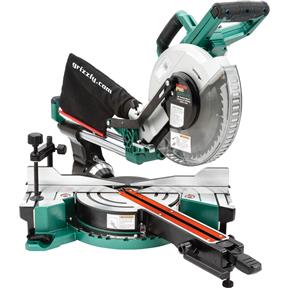
On Amazon the pick is the DEWALT DWS779, a 12 in double bevel sliding compound saw that cuts wide boards. Our DEWALT DWS779 miter saw review covers it. The Grizzly alternative is the PRO T31634, a 10 in double-bevel sliding compound miter saw, owner-rated 4.4 on grizzly.com across 27 reviews. The 12 in saw cuts wider boards; the 10 in saw is smaller and lighter, which helps in a small garage. For flooring and trim, either one is the right tool, and it pays for itself against an installer quote faster than most tools. Price the job in our flooring installation cost calculator to see the margin.
Power, space and outfeed: planning the saw station
Before you pick a tier, mark the floor. A table saw needs clear space in front for you, behind for the offcut, and to the side for a full sheet of plywood to pass the blade. As a rule of thumb, plan on the length of the longest board you cut plus the length of the saw, in a straight line. In a one-car garage that usually means the saw lives on a mobile base and rolls out into the middle of the floor for a job, then tucks against a wall.
A miter saw wants the opposite: a fixed station with support on both sides at the height of the saw table, so long boards stay level through the cut. A folding stand works for occasional use. A bench built to the saw table height is better for daily use, and the adjustable benches in the gear cards above are a good base for it.
Power is the last check. A benchtop or jobsite saw draws up to 15 amps and should have a 20 amp circuit to itself or at least not share it with the compressor and a dust collector. A cabinet saw wants its own 240V circuit. If you are unsure how much your panel can carry, price the work with the electrical panel upgrade cost calculator before buying the saw.
Blades, fences and accessories worth buying
A saw is only as good as the blade on it. The stock blade on most saws is adequate for framing lumber and rough cuts. For plywood and finish work, a higher tooth count blade gives a cleaner edge, and a thin-kerf blade suits the lower-power benchtop saws because it asks less of the motor. For a miter saw, a fine-tooth crosscut blade is the single best upgrade for trim and flooring.
Beyond the blade, three accessories earn their place: a good push stick set, a zero-clearance insert that supports the wood right at the blade, and an outfeed support that keeps long boards from tipping off the back. A better miter gauge or a crosscut sled turns a benchtop saw into a far more accurate crosscutting tool, which addresses the weakest part of most jobsite saws.
Finally, connect the saws to dust collection. Every saw in this guide has a dust port. A shop vacuum is the minimum, and a wall-mount collector and a hanging air filter, both covered in the garage workshop setup guide, are the stronger answer for a shop attached to a house.
Safety, stated plainly
A table saw is the tool that hurts people, mostly through kickback. Keep the riving knife fitted, keep the guard on, use the fence for every rip, use a push stick, and never stand directly behind the blade. A miter saw should be clamped or held with the hand well clear of the blade path, and the blade should come to a full stop before you lift it. Wear eye and hearing protection for both, and read the manual for your model.