Water heater comparison
Heat Pump vs Gas Water Heater: Cost Comparison
A heat pump water heater moves heat rather than making it, which is why it can use a fraction of the energy of a conventional electric tank. It also needs space, air and a drain, and those requirements rule it out of some installations.
Heat pump water heater
$1,800 to $4,500 installed
Gas tank
$1,200 to $3,500 installed
| Feature | Heat pump water heater | Gas tank |
|---|---|---|
| Installed cost | $1,800 to $4,500 | $1,200 to $3,500 |
| Running cost | Usually lowest | Low where gas is cheap |
| Space required | Large, needs air volume | Standard closet |
| Condensate drain | Required | Not required |
| Venting | None | Flue or direct vent required |
| Noise | Audible, like a fridge | Quiet |
| Cools the surrounding space | Yes, a side effect | No |
| Rebates commonly available | Yes | Rarely |
Heat pump water heater
- Two to three times more efficient than a standard electric tank
- Frequently eligible for utility rebates and tax credits
- No combustion, no flue, no carbon monoxide risk
- Dehumidifies and cools the space it sits in, useful in a basement
- Higher upfront cost
- Needs a large enough space with adequate air
- Needs a condensate drain
- Audible fan and compressor
Gas tank
- Lower upfront cost
- Fast recovery for large households
- Compact, fits a standard closet
- Often works during a power outage
- Needs a gas line and correct venting
- Combustion products and carbon monoxide risk if venting fails
- Running cost tracks gas prices
- Lower efficiency than a heat pump unit
The verdict
Choose a heat pump water heater if you have a basement, garage or utility room with space and a drain, and check what rebates apply locally before comparing prices, because they often change the answer. Choose gas if the unit lives in a small interior closet, if you already have a gas line and cheap gas, or if a large household needs the faster recovery. Any gas appliance install is a licensed trade and permitted job, and a working carbon monoxide alarm belongs in any home with combustion appliances.
If the heat pump wins on your rates, our Rinnai REHP50 review covers the space, noise and condensate drain requirements that decide whether one will actually fit where your old tank sits.
Doing the water heater job yourself?
Amazon picks · SponsoredA contractor quote is mostly labor. If that estimate felt steep, here is the exact gear to tackle this job yourself. As an Amazon Associate we earn from qualifying purchases, at no extra cost to you.
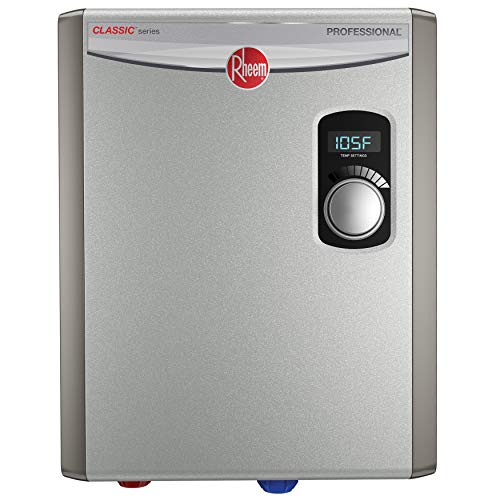
Self-modulating electric tankless, up to 4.4 GPM for whole-home hot water.
View on Amazon
$939.60
Standard tank replacement sized for a 3 to 5 person household.
View on Amazon
$40.49
Absorbs thermal pressure to protect the tank and plumbing, 3/4 in MNPT.
View on Amazon
$25.49
Cast-iron 8 to 14 in wrenches for water connections and fittings.
View on AmazonFrequently asked questions
How much can a heat pump water heater save?
Against a standard electric resistance tank, typically a substantial share of water heating energy, because it moves heat instead of generating it. Against gas the comparison depends entirely on local electricity and gas prices, so run your own utility rates rather than trusting a national figure. Check current rebate and tax credit programs too, since they often change the payback more than the efficiency does.
Where can a heat pump water heater be installed?
It needs a space with enough air volume for the manufacturer specification, commonly a basement, garage or large utility room, plus a condensate drain and adequate clearance. A small sealed closet usually will not work without ducting. It also cools and dehumidifies the space it sits in, which is welcome in a basement and unwelcome in a conditioned living area.
Are heat pump water heaters noisy?
They run a fan and a compressor, so they are audible in a way a tank is not, usually compared to a refrigerator. In a basement or a garage that is a non-issue. Adjacent to a bedroom it can be, which is worth checking before committing to a location.
Do I need a permit to replace a water heater?
In most jurisdictions yes, and gas work in particular is a licensed trade. Permits cover venting, gas connections, seismic strapping where required, temperature and pressure relief piping and electrical work. Beyond the legal point, a badly vented gas appliance is a carbon monoxide risk, which is a reason to use a licensed installer regardless of what the rules say locally.